Celestial Drift
Sep 30, 2026
Celestial Drift
Most of that night at Payne Lake, I was looking south.
That's where the Milky Way was rising, and since photographing it was the reason I'd gone out there in the first place, that's where most of my attention had been.
Then, as tends to happen with my photography, I turned around.
I looked north.
There wasn't anything particularly dramatic happening that I could see with my eyes. It was dark enough that I could barely make out the clouds above the tree line. Off toward the horizon, I could see the glow from Tuscaloosa in the distance.
But something about the scene made me curious.
So I pointed the camera in that direction and thought, let's see what it looks like this way.
I set the exposure for around 15 seconds and opened the shutter.
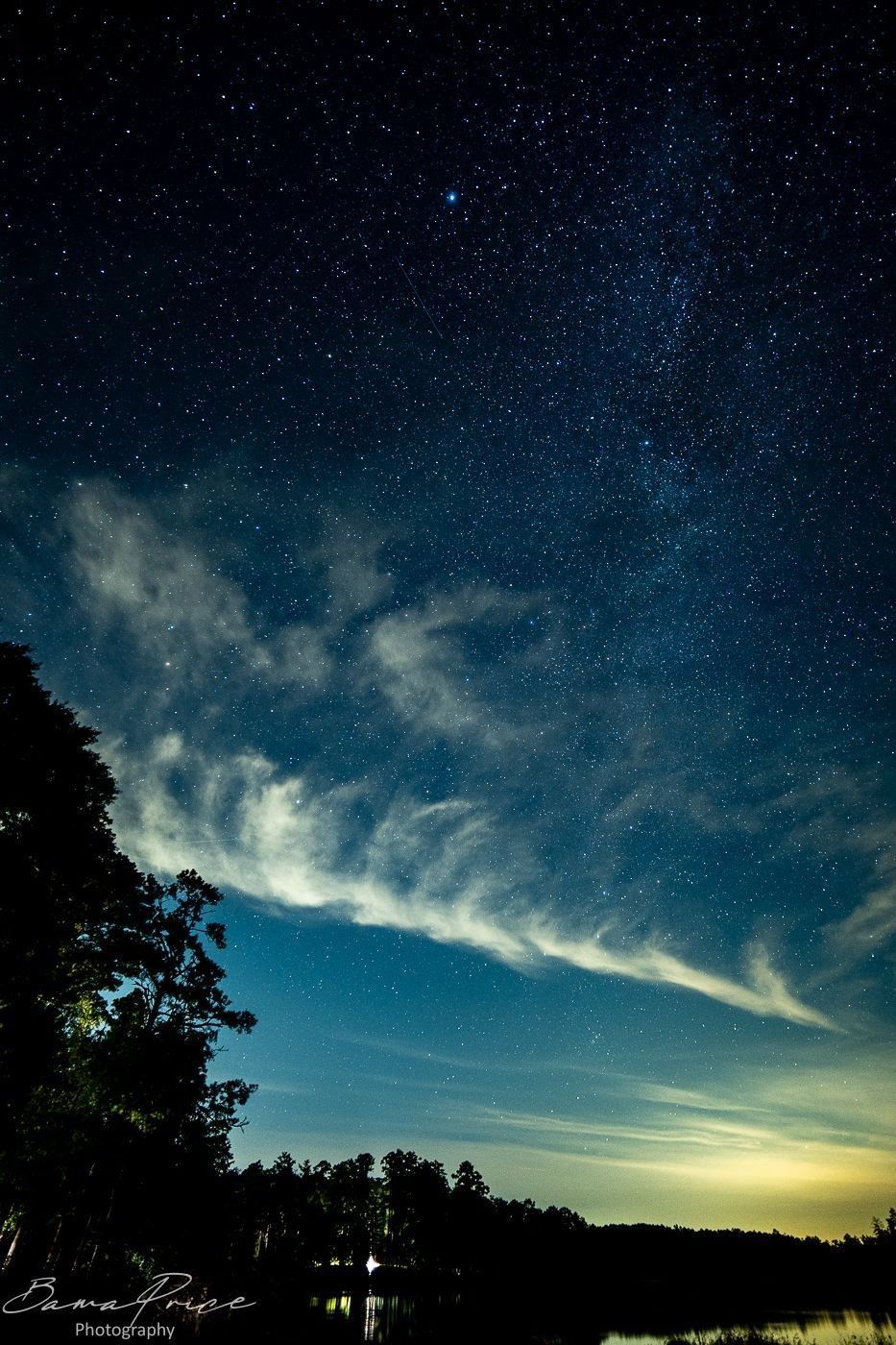
The camera saw more than I could.
The clouds that had been barely visible to my eyes suddenly had shape and texture. Stars appeared throughout the sky. The tree line became a dark silhouette against the horizon, and the water below reflected just enough of the night to complete the scene.
And then there was that glow.
The camera's long exposure made the light from Tuscaloosa much more prominent than it appeared while I was standing there.
I could have tried to minimize it. I could have cropped it away and presented a darker, seemingly untouched night sky.
But that wasn't what was there.
The glow was part of the scene.
After writing recently about Starfield and how much of the night sky we've lost from view because of light pollution, I suppose Celestial Drift shows the other side of that story.
Even at Payne Lake, where the sky was dark enough for me to photograph the Milky Way, the lights of a city many miles away were still visible along the horizon.
But I didn't make this photograph as a statement about light pollution.
I made it because I turned around.
I saw something that made me curious.
And when the exposure finished, the camera showed me a scene I hadn't been able to fully see for myself.
That's one of the things I'm beginning to enjoy most about photographing at night.
During the day, I usually know what I've photographed the moment I press the shutter.
At night, sometimes I have to wait 15 seconds to find out.
And sometimes what the camera sees is better than what I expected.
Available as Fine Art
Celestial Drift is available in my Night Skies Collection, featuring my fine art photographs of the Milky Way, stars and Alabama's night sky.
You can explore the collection at Bama Price Photography.