Starfield
Sep 16, 2026
Starfield
Most of my photographs have something to anchor them.
A mountain. A waterfall. The sun breaking through the clouds. Even when I'm photographing the night sky, there's usually something else in the frame—a shoreline, a group of trees, something that connects the sky to the landscape below it.
Starfield doesn't have any of that.
It's just the sky.
I made this photograph during my night at Payne Lake, when I finally captured my first successful images of the Milky Way. I'd spent the night experimenting with something completely different from the landscapes I normally photograph, learning what my camera could see after the sun disappeared.
At some point, I looked up.
Away from the brighter portion of the Milky Way, I could vaguely make out another section stretching across the sky. My eyes could see that something was there, but not everything.
The camera could see more.
So instead of trying to find something to put in front of it, I pointed the camera up and let the sky fill the entire frame.
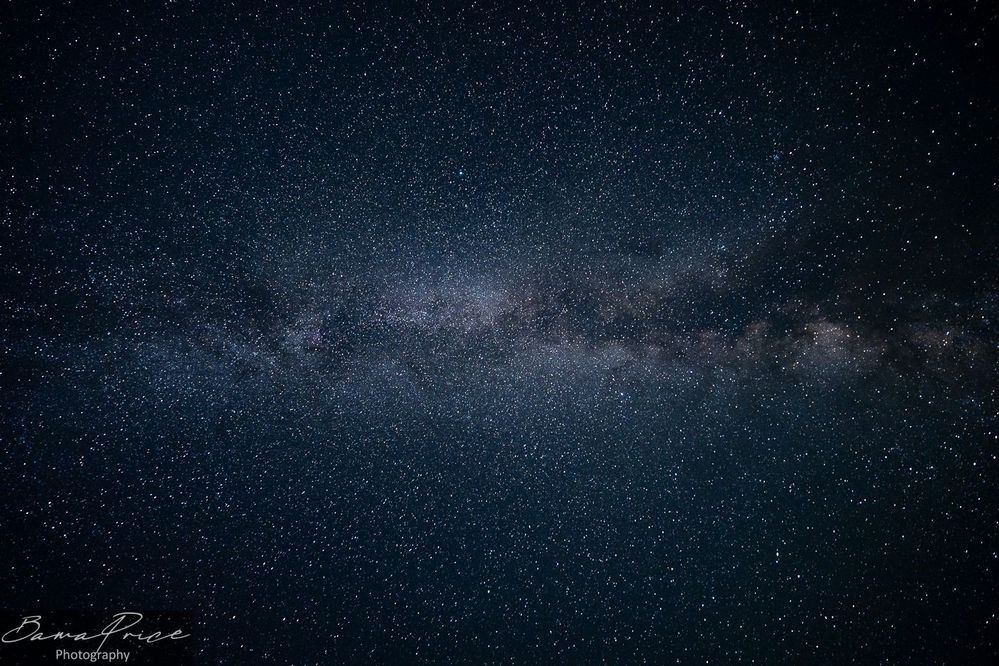
There isn't a tree along the bottom.
There isn't a lake reflecting the stars.
There isn't a mountain silhouette or anything else competing for attention.
There are just stars.
And an incredible number of them.
That was what caught my attention when I went through the photographs from that night. Without anything else in the frame, I began to notice just how vast the sky looked.
To bring out more of what was there, I combined five exposures of the same scene. Stacking the images allowed the camera to reveal more of the stars and detail than I could see standing there with my own eyes.
And that's part of why I chose Starfield to write about.
This isn't an image from NASA or a screenshot from a telescope somewhere. I took this photograph standing beneath the night sky in Alabama.
Those stars are really there.
I think that's easy to forget because so many of us rarely get to see a sky like this anymore. Light pollution has hidden much of the night sky from view in the places where we live, and there's something sad about realizing how much we've lost the ability to see.
Standing beneath a darker sky and then seeing what my camera was able to capture reminded me just how much is still above us—even when we can't see it from our own backyards.
The result was Starfield.
It's different from the way I normally compose a photograph. Usually, I'm looking for a subject—something that immediately gives your eye a place to land.
This time, the Milky Way was the subject.
The sky didn't need anything else.
I didn't make that decision because I was trying to change the way I photograph or prove that a composition could work without a foreground.
It simply felt right.
And sometimes that's enough.
Available as Fine Art
Starfield is available in my Night Skies Collection, featuring my fine art photographs of the Milky Way, stars and the night sky.
You can explore the collection at Bama Price Photography.