Getting Lost on the Way to Avalanche Lake
Aug 19, 2026
Getting Lost on the Way to Avalanche Lake
We expected a short hike to Avalanche Lake.
Before we ever set foot on the trail, we'd already managed to get lost.
My brother had only been living in Montana for a few months, but he assured me he'd been there before and knew exactly where we were going. Going-to-the-Sun Road was still closed, so we pulled into an area being used as a makeshift parking lot until the nearby campground opened for the season.
There were cars everywhere.
Somewhere among all of them was the trailhead.
The problem was, we couldn't find it.
I was the tourist. My brother was now the Montana resident. Naturally, I followed him.
Three laps around the parking lot later, carrying a backpack full of camera gear and one bottle of water for what I had been told was only going to be about a two-mile hike, I was already getting tired—and we hadn't even started hiking yet.
Eventually, I happened to look back and spotted the trailhead tucked behind a large camper van that had been blocking it from view.
Mystery solved.
We finally started up the trail, where we soon passed park rangers warning hikers that bears had been spotted in the area.
We kept going.
Before long, I heard the rushing water of Avalanche Creek and found my first excuse to stop.
Coming from Alabama, I'm accustomed to creeks and rivers with a greenish tint. This water was different. It was incredibly clear, with a beautiful blue color running through the cascades.
I stepped slightly off the trail where I wouldn't be in anyone's way, set up the camera, and photographed the water rushing through the forest.
And, if I'm being completely truthful, it also gave me an excellent excuse to take that backpack off for a few minutes and catch my breath after our three-lap warm-up around the parking lot.
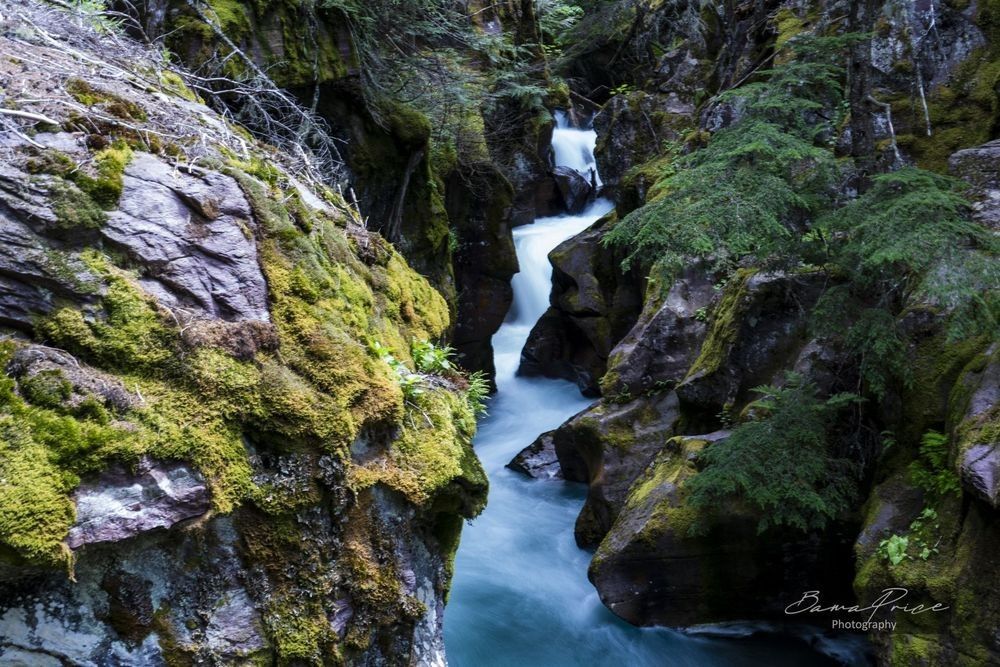 I photographed Avalanche Creek Cascades with my Sony 28–70mm lens.
We continued toward the lake, stopping occasionally along the way. As the forest began opening up, I started getting my first real views of the mountains surrounding us.
That's when Bearhat Mountain stopped me again.
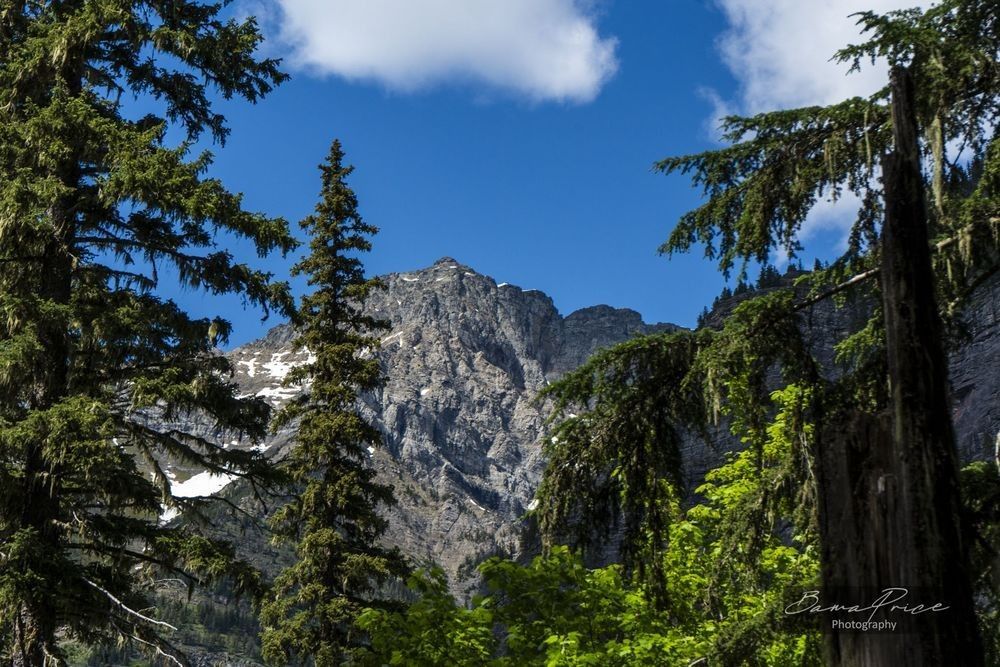 Bearhat Mountain was also photographed with my Sony 28–70mm lens—my usual walking-around lens.
I had seen plenty of photographs of Glacier National Park before this trip, but photographs don't prepare you for actually standing among those mountains.
There is a scale to Glacier that is difficult to describe.
You don't simply look at the mountains.
You feel their presence.
We continued up the trail until we reached another opening along Avalanche Creek. A group of people had stopped there taking selfies beside the rushing water, and through the opening I could see toward Avalanche Lake and the mountains beyond.
I saw a photograph.
I wanted the creek leading toward the lake, the mountains rising behind it, and three waterfalls I could see dropping down the distant mountainside.
So I pulled out my Sigma 60–600mm lens and tripod.
That lens weighs around five and a half pounds by itself, so this wasn't exactly a quick handheld photograph. I stepped ankle-deep into Avalanche Creek in my waterproof hiking boots, set up the tripod, and started working on the composition.
My backpack—with my bear spray—was sitting about twenty feet away on the bank.
I was looking through the camera, concentrating on getting everything in focus, when I heard my brother behind me.
"Chris. There's a bear."
I turned to my left.
Across the creek, a grizzly was walking out onto one of the fallen trees.
So much for the landscape photograph.
I immediately swung the camera and that enormous 60–600mm lens around on the tripod and started trying to focus on the bear.
I'd only owned the lens for a few months and was still learning it. This probably wasn't the ideal moment for a field lesson, but the bear wasn't particularly concerned with my learning curve.
Then, for just a moment, it stopped.
And posed.
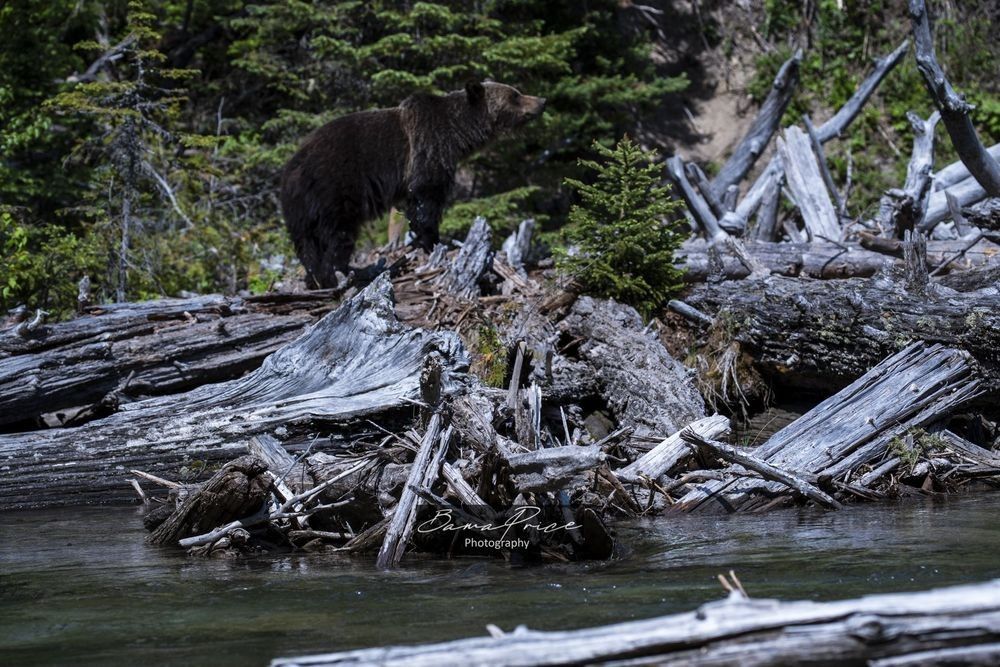 Avalanche Creek Monarch was photographed with my Sigma 60–600mm lens.
Behind me, people were beginning to get nervous.
My brother informed me that the bear was coming our way.
I looked around at the group of roughly ten people gathered there and figured we had enough people—and enough bear spray among us—that we were going to be okay.
Mine, of course, was still safely protecting my backpack twenty feet away.
I kept photographing.
When the bear moved closer, I finally decided it was time to call it. I took my time breaking down the camera and lens, packed everything away, and we continued up the trail toward Avalanche Lake.
After getting lost before the hike, carrying all that camera gear up the mountain, stopping for cascades and mountain views, and unexpectedly photographing a grizzly, we finally reached the reason we'd started walking in the first place.
Avalanche Lake.
For this photograph, I switched to my Sony 16mm wide-angle lens.
There was no way I wanted to compress this scene.
I wanted all of it.
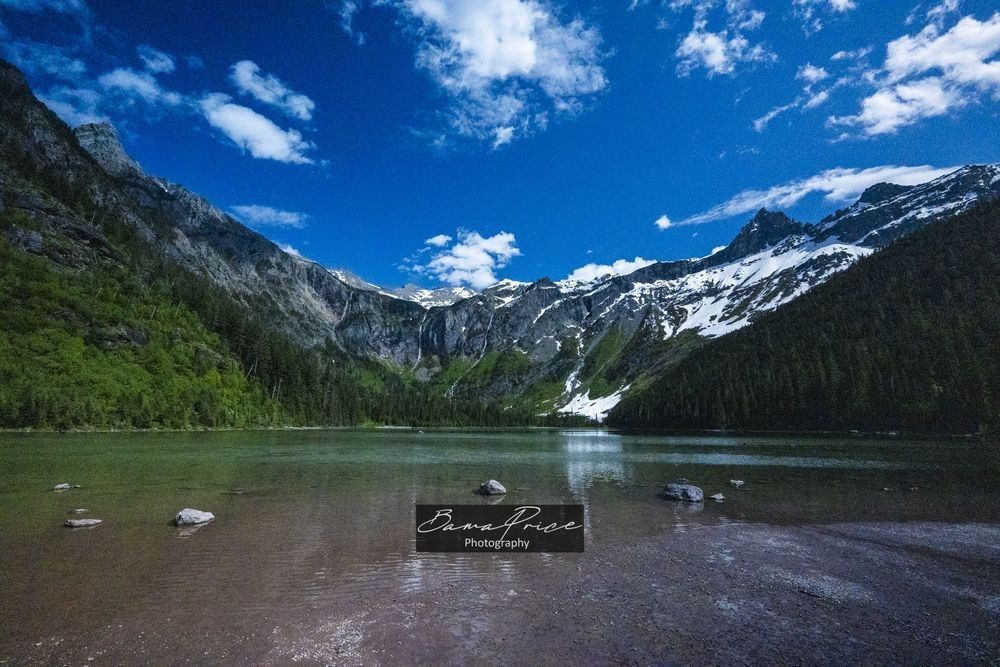
Standing there looking across the water toward those enormous mountains was the payoff for everything that had happened along the trail.
And then there was the hike back.
Remember that "two-mile hike" I had packed one bottle of water for?
Once we got back to my brother's house and finally had enough signal to look it up, we discovered we'd actually hiked roughly six miles round trip.
I was ready to kill him.
But I'd do the hike again.
We saw mule deer. We walked beside some of the clearest water I'd ever seen. I photographed Bearhat Mountain, came face-to-face with an unexpected opportunity to photograph a grizzly, and eventually stood on the shore of Avalanche Lake surrounded by the giants of Glacier National Park.
That's the feeling I keep returning to when I think about Glacier.
Awe.
The photographs are my attempt to bring a little of that feeling home with me.
Available as Fine Art
The photographs featured in this story are available in my Glacier National Park Collection. You can view them and the rest of my Montana fine art prints here: